Sites like the Heritage Foundation and the Federalist Papers have noticed something interesting about the decision of Paypal, Bruce Springstein, Disney, the State (governor) of New York, etc. to attempt to boycott states like North Carolina and Mississippi. Said boycotts are in response to these states' attempts to enact even the most toothless lawsrecognizing the rights of conscience and Religious Liberty.
There is a certain double-standard at play here--and it is not the only double-standard. After all, many of these folks who are so adamant about the importance of protecting so-called gay (and transgendered) rights from the consciences of Christians will gladly turn a blind eye to the treatment of those same gays when they are beheaded by Mohammedans or imprisoned by Hindus.
Nor is this the only way in which the religious freedoms of Christians in general (and Catholic in particular) are under assault from the Left in America.
The thoughts, musing, and above all reflections of a hope-filled pessimist and a faithful skeptic. I'm a husband, a father, a teacher, and a scientist. I'm a corrective Thomist, a bibliophile, and a lay Dominican who is trying to pass the fruits.
Contra Mozilla
[close]
Firefox users we wanted to take this space to let you know what Mozilla, the company that makes Firefox has been doing, and it's not good. Mozilla recently forced its CEO to resign because he had, 6 years ago, donated $1,000 to a pro-family political group. Apparently Mozilla is intolerant of anyone that disagrees with their Liberal/progressive view of politics. To read more please visit WhyFirefoxIsBlocked.com. We aren't blocking Firefox, but we feel it is important to let you know what's going on. For those who are curious, the reason why we are not blocking firefox is that the script to do so also blocks a variety of firefox alternatives, such as IceDragon and others which are similar to firefox and based on the same open-source code. We do think it is important to push back on this issue: for starters, you can leave firefox a comment here. You can also switch to another browser: here are six more free browsers (besides IceDragon) which are supposed to be similar to FireFox (because they are based on the same open-source code) but which are not otherwise affiliated with Mozilla.
Showing posts with label Freedom of Religion. Show all posts
Wednesday, April 13, 2016
Monday, July 6, 2015
Good Queen Bess?
Suffice it to say that I agree with Fr. Longenecker's assessment of the reign of Queen Elizabeth. She was a tyrant as bad as the rest of her dynasty, a dynasty which happily ended with her. Oh, her reign was certainly good for England if one wants to argue that it keep England distant from those foreign powers which happened to have (at least nominally) Catholic rulers. Of course, England could have been made great without systematically persecuting the Church, and could have been more than great in the merely secular sense. The Catholic Church in England and Scotland may have been one of the more corrupt branches in those days. But what came after was no improvement:
What I have never understood is why Elizabeth did not avoid all the difficulties and simply maintain the Catholic faith that her half-sister Mary had re-established. She could have legitimized her claim to the throne through a marriage to Philip of Spain or a French Catholic prince. She could have won the hearts of her people who were still much more in favor of the old Catholic faith, and if she had borne children would have established security during her reign and secure dynasty. She chose not to, and the only reason one must assume, is that she did not wish to share her throne with anyone—especially a powerful husband.Come rack, come rope... The Church in England, indeed in Europe, did indeed need reforming. The problem of the Reformation is that it threw out good doctrines along with bad practices, and then implemented some bad practices of its own. England under the Tudor dynasty was not only no exception to this rule, but was indeed arguably an exemplar of it.
Her intransigence brought about continued insecurity in England and division in war-torn Europe. It necessitated the murder of her cousin Mary, Queen of Scots, and kept her country on a knife edge of religious strife, immanent civil war and the threat of external invasion....
For indiscriminating fans of popular history she might still be the red-haired, haughty monarch—the proud and popular Protestant queen, “with the heart and stomach of a king” but for many others she remains the true daughter of her father—a stubborn, cruel and heartless tyrant.
Thursday, April 16, 2015
Misleading Misreading of the Day--Matthew 5:41
I've finally encountered an actually interesting attempt to argue that people of faith should bake the cake. It hinges on the teachings in Matthew 5 about how to respond to those who wrong you:
Many of the problems of this interpretations of Matthew 5 have been addressed elsewhere. One which stands out in particular to me are the fact that there is a difference between going along with somebody you don't like, even doing something for them which you don't want to do (or permitting them to wrong you in some way); and willingly helping them to do something which you know (or at least believe) to be wrong. Another is that there is a difference between being extra kind to others, including those who want to wrong us (which is what the teaching in Matthew suggests), and helping these people to wrong us.
Christ tells us to turn the other cheek, even to become servants; but a servant is not a doormat. As one commentator notes, turning the other cheek was a very edgy teaching precisely because the expected reaction was to grovel in the dirt, quite literal to fall down at the other's feet (doormat, much?). The teaching is to not resist evil with more evil--which in turn means not participating in the other's evil and helping him to commit it. Refusing service is not in and of itself evil, and if there ever was a good reason to refuse service it is because the service is known to be for an evil end.
To go back to the (imaginative, I'll grant) misreading, the lady who wrote the post which inspired this response attempts to set the stage (with [my comments]):
Even supposing that the Roman soldier was planning to do such a thing, merely carrying his equipment does not make the Israelite in question a willing participant in the campaign. This is true for the simple reason that the Israelite pressed into service does not know that this is what the soldier is planning to do, or that this is the purpose for which he is being pressed into service. Odds are rather against it, in any case. So at worst, the Israelite Disciple of Christ in question becomes a material participant in evil, and not a formal one (to make use a of a significant distinction delineated here). But to bake a cake for an event whose sole purpose is to give witness to an untruth, and whose major result will be the celebration of a grave sin? That seems to me to be a bit closer to providing support for that event, and thus for that sin. Such support is itself a sin, and thus must be resisted. Nor should the laws of a really free nation compel men to violate their consciences in this way. Such laws do not promote "equality" or "charity" or "tolerance/acceptance", but rather tyranny.
“You have heard that it was said, ‘An eye for an eye and a tooth for a tooth.’ But I say to you, Do not resist one who is evil. But if any one strikes you on the right cheek, turn to him the other also; and if any one would sue you and take your coat, let him have your cloak as well; and if any one forces you to go one mile, go with him two miles. Give to him who begs from you, and do not refuse him who would borrow from you.The argument of the article hinges in particular on Matthew 5:41 t argue that if someone forces you to bake a cake for a "gay wedding" then your response should be to bake two. The author of the post also leaves the disclosure that she does in fact support "gay marriage," and this is one of the few arguments I have found which cannot simply be reduced to "Do this because we told you too, bigot," and so I commend her for making it. In these polarized times it is far too rare to see any attempt at making a good-faith argument as to why people should be forced to violate their consciences as the price for doing business (read: making a living for themselves).
Many of the problems of this interpretations of Matthew 5 have been addressed elsewhere. One which stands out in particular to me are the fact that there is a difference between going along with somebody you don't like, even doing something for them which you don't want to do (or permitting them to wrong you in some way); and willingly helping them to do something which you know (or at least believe) to be wrong. Another is that there is a difference between being extra kind to others, including those who want to wrong us (which is what the teaching in Matthew suggests), and helping these people to wrong us.
Christ tells us to turn the other cheek, even to become servants; but a servant is not a doormat. As one commentator notes, turning the other cheek was a very edgy teaching precisely because the expected reaction was to grovel in the dirt, quite literal to fall down at the other's feet (doormat, much?). The teaching is to not resist evil with more evil--which in turn means not participating in the other's evil and helping him to commit it. Refusing service is not in and of itself evil, and if there ever was a good reason to refuse service it is because the service is known to be for an evil end.
To go back to the (imaginative, I'll grant) misreading, the lady who wrote the post which inspired this response attempts to set the stage (with [my comments]):
To the Israelites, the Romans were evil and ungodly. They had no place ruling over God’s chosen people in God’s chosen nation. That land had been promised to Moses and his descendants when God brought them out of Egypt. Their very presence in the land was blasphemous. [There's a problem with this statement as it is. That problem is that the Temple in Jerusalem was built with an outer court for the Gentiles, which would presumably include Romans. At worst, it was an outrage that the Romans were present as conquerors--but their very presence could hardly be a blasphemy in and of itself].Ah, but therein lies the rub. There is nothing actually wrong with marching with the soldier for a mile, or two, or ten. That Christ is telling us to do this rather explicitly means that there is nothing sinful about providing aide to the soldier, even if that soldier was part of an army occupying Israel. The law in question was not particularly set up to oppress the Israelites (or any other conquered people), and there weren't in all probability soldiers going door-to-door to ask after Israelites who might object to carrying their load for a mile. Finally, the Israelite would not (or would not necessarily) know whether the soldier in question was taking his gear off to some evil purpose. Might the soldier be planning to participate in an unprovoked campaign of terror or Genocide? That seems out of character for the Romans (the phrase pax Romana is not for nothing). They would seem to be more interested in putting down uprisings (keep order) or perhaps expanding their territory than ridding their empire of their own subjects, however troublesome.
One of the Roman laws stated that any man could be required to drop what he was doing and carry a Roman soldier’s equipment for him for up to a mile. In the Sermon on the Mount, with his followers gathered around him, Jesus referenced that law and told his followers what they should do in that case:
“If anyone forces you to go one mile, go with them two miles.” ~Matthew 5:41
Go with them two miles. That was not the advice that most of the people in the crowd that day had been hoping for. That was not the conclusion that they would have come to on their own, following this man that they hoped would lead them to victory over the Romans. That was certainly not respecting their religious beliefs [Jesus was God. He is the source of religious truth, and so He need not respect a false "religious belief." But the state is not God. The state is more akin to Caesar. Render unto Caesar what is Caesar's...] — go with them two! What if their neighbors saw! What if seeing them carrying the Roman’s equipment caused other Jews to think the Roman oppression was okay? [This is a false equivalency. Part of the objection to providing services to sinful events is the possibility that doing so will lead to scandal, but at this point in time (and cultural decay) it is a very minor part indeed. The bigger problem is that this is participating in those events, and thus to some extent in the sins which they represent] What if there was other work that needed to be done — good work, charity work even, but they spent all that time carrying equipment for the evil oppressor? [Is this even an argument which has actually been made? If so, I am not aware of it. It can't be a really serious argument, since it presupposes that the subjugated person in question would otherwise be spending all of his time doing good works and acts of charity, or at the least otherwise providing for his and his family's needs. The argument in religious liberty cases is precisely that we should be allowed to turn down opportunities for doing this, not because we have something better to be doing with the time, but because it is better to do nothing at all with the time then to do something which violates our consciences.]
Even supposing that the Roman soldier was planning to do such a thing, merely carrying his equipment does not make the Israelite in question a willing participant in the campaign. This is true for the simple reason that the Israelite pressed into service does not know that this is what the soldier is planning to do, or that this is the purpose for which he is being pressed into service. Odds are rather against it, in any case. So at worst, the Israelite Disciple of Christ in question becomes a material participant in evil, and not a formal one (to make use a of a significant distinction delineated here). But to bake a cake for an event whose sole purpose is to give witness to an untruth, and whose major result will be the celebration of a grave sin? That seems to me to be a bit closer to providing support for that event, and thus for that sin. Such support is itself a sin, and thus must be resisted. Nor should the laws of a really free nation compel men to violate their consciences in this way. Such laws do not promote "equality" or "charity" or "tolerance/acceptance", but rather tyranny.
Wednesday, April 1, 2015
Words of Hope for Our Culture in These Dark Times
Our only final hope is in God, but as a culture there is certainly precedence that we may survive these dark times. And dark times they are. The LEFT seems to be ascendant in what remains of Christendom, which is perhaps another way of saying that Christendom is to have no remains in the West. We will not be granted any terms save unconditional surrender, and this it may not be enough:
The barbarians of the last Dark Age came from outside the walls of Rome, had little trouble getting in because of the decay from within. We certainly have our barbaric outsiders--ISIS, Boko Haram, Al Qaeda, and I'm sure there are some who are not Islamic. We also have our interior decay, which shows that the barbarians are already running things here, too.
But, as I mentioned, there is some hope that our culture can re-emerge after this dark age, even if none of us will be alive to see it. Rod Dreher discusses the glimmers of this hope, whcih he calls the "Benedict Option." He quotes Alasdair Macintyre to the effect that we can hope that our culture, too, will find its St. Benedict:
It may be that for those of us in that position, the right patrons are Athanasius, John the Baptist, Thomas Beckett, John Fisher, and (most of all) Thomas More.
Religious liberty is the terms of surrender the Right is requesting in the culture war. It is conservative America saying to the cultural and political elites, you have your gay marriage, your no-fault divorce, your obscene music and television, your indoctrinating public schools and your abortion-on-demand. May we please be allowed to not participate in these?
But no. Tolerance isn't the goal. Religious conservatives must atone for their heretical views with acts of contrition: Bake me a cake, photograph my wedding, pay for my abortion and my contraception....
Even in abortion, the Left is tired of long-observed truces. The Hyde Amendment, which for decades has restricted federal funding of abortion providers while never intruding on the freedom of women to abort their children, is no longer tolerated by the abortion lobby, which even killed a human trafficking bill over it.
As stunning as their ambitions of total victory is their continued pretense to be fighting a defensive war. It should be obvious to all that the Left long ago dropped its love of pluralism and tolerance — if that ever was their goal.The Left is not interested in our terms for surrender--which is a very good reason for us not to surrender! To make use of an often-suggested metaphor, they are in the phase of the culture wars in which they are patrolling the wreckage of the battle fields in search of survivors to execute.
The barbarians of the last Dark Age came from outside the walls of Rome, had little trouble getting in because of the decay from within. We certainly have our barbaric outsiders--ISIS, Boko Haram, Al Qaeda, and I'm sure there are some who are not Islamic. We also have our interior decay, which shows that the barbarians are already running things here, too.
But, as I mentioned, there is some hope that our culture can re-emerge after this dark age, even if none of us will be alive to see it. Rod Dreher discusses the glimmers of this hope, whcih he calls the "Benedict Option." He quotes Alasdair Macintyre to the effect that we can hope that our culture, too, will find its St. Benedict:
It is always dangerous to draw too precise parallels between one historical period and another; and among the most misleading of such parallels are those which have been drawn between our own age in Europe and North America and the epoch in which the Roman Empire declined into the Dark Ages. None the less certain parallels there are. A crucial turning point in that earlier history occurred when men and women of good will turned aside from the task of shoring up the Roman imperium and ceased to identify the continuation of civility and moral community with the maintenance of that imperium. What they set themselves to achieve instead—often not recognising fully what they were doing—was the construction of new forms of community within which the moral life could be sustained so that both morality and civility might survive the coming ages of barbarism and darkness. If my account of our moral condition is correct [one characterized by moral incoherence and unsettlable moral disputes in the modern world], we ought to conclude that for some time now we too have reached that turning point. What matters at this stage is the construction of local forms of community within which civility and the intellectual and moral life can be sustained through the new dark ages which are already upon us. And if the tradition of the virtues was able to survive the horrors of the last dark ages, we are not entirely without grounds for hope. This time however the barbarians are not waiting beyond the frontiers; they have already been governing us for quite some time. And it is our lack of consciousness of this that constitutes part of our predicament. We are waiting not for a Godot, but for another—doubtless very different—St. Benedict.Dreher states optimistically that we may not have reached the point-of-no-return, but I am a bit more pessimistic on that point. It seems to me that victory is beyond our grasp, though I pray that I am wrong. Victory is the primary goal in the culture wars, I suppose, and (more importantly) peace. But the secondary goal, which persists long after the first is gone, is to hold off our culture's utter annihilation until the next Benedict can get these community outposts established. I am left to wonder what such things would look like. And, it seems to me that there is one other right response, the only one left for us laymen who cannot simply leave all to enter the monastic life: we must remain at our posts and do our right duties as best we are able, even as society crumbles around us.
It may be that for those of us in that position, the right patrons are Athanasius, John the Baptist, Thomas Beckett, John Fisher, and (most of all) Thomas More.
Monday, March 30, 2015
Protecting Religious Freedom
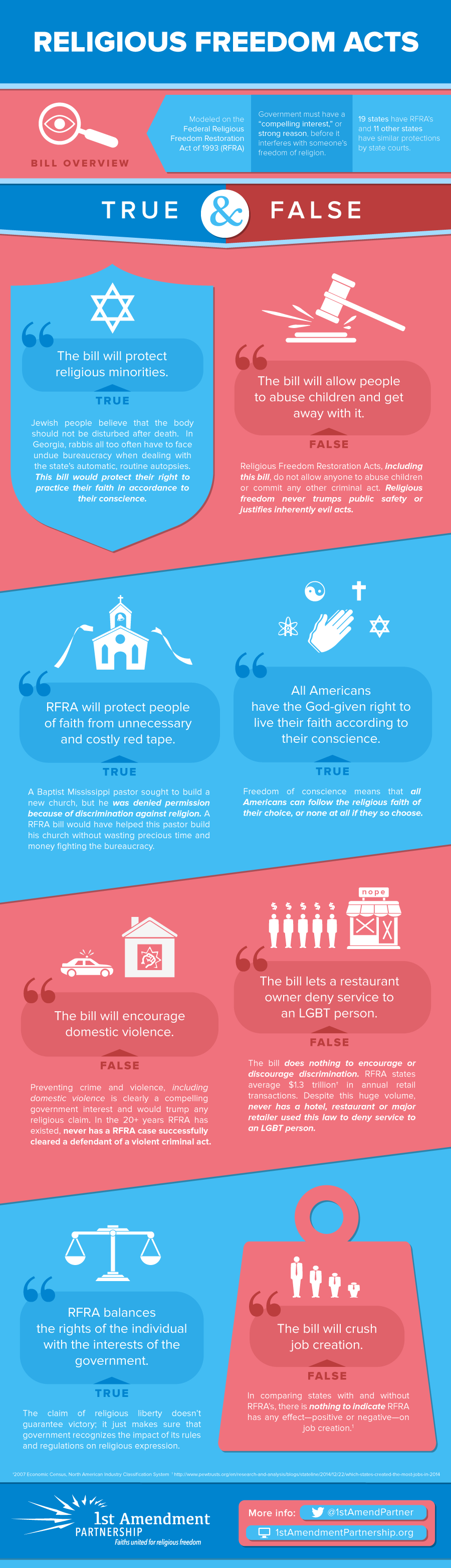
I've read a few articles of late about Indiana's recent passage of a Religious Freedom Protection Act. It seems to me that the informed opinion is that this act--like laws in 19 other states which have been passed since the early 1990's--basically just weighs religious liberties against compelling interests of the state. My comment here is that it is not a good thing that we need such an act, a point which I have noted before. Nevertheless, the state has made it quite clear that it will overreach wherever possible, including by attempting to stamp out religious liberties.
The most visible way in which it does this is by trying to invoke so-called "gay rights" (hence all of the hysteria of how this law which never mentions GBLT-etc folks is somehow "anti-gay). Invoking so-called "women's rights" arguably a close second. Forcing Christians to participate in so-called "gay marriage ceremonies" as photographers, bakers, floral-arrangers, and perhaps even as ministers is the all-too-common example of the former; the Obama administration's rather tyrannical HHS contraceptive-abortifacent-sterilization mandate is an example of the latter.
In all, this law is meant to be a sort of shield for religious liberties, though I suspect that it may be a rather nebulous one. Case in point, I have yet to hear of any Christian who is sued for exercising his conscience cite any of the various RFRA-analogs. This isn't the Arizona version of the bill, after all.
On the other hand, it seems that these bills provide a flimsy shield at best, since it will largely end up being the state which gets to decide when the state has compelling interests. Not to mention, that is repeat, but the fact that we have sunk so far as to need a law like this is also a rather ill omen.
The most visible way in which it does this is by trying to invoke so-called "gay rights" (hence all of the hysteria of how this law which never mentions GBLT-etc folks is somehow "anti-gay). Invoking so-called "women's rights" arguably a close second. Forcing Christians to participate in so-called "gay marriage ceremonies" as photographers, bakers, floral-arrangers, and perhaps even as ministers is the all-too-common example of the former; the Obama administration's rather tyrannical HHS contraceptive-abortifacent-sterilization mandate is an example of the latter.
In all, this law is meant to be a sort of shield for religious liberties, though I suspect that it may be a rather nebulous one. Case in point, I have yet to hear of any Christian who is sued for exercising his conscience cite any of the various RFRA-analogs. This isn't the Arizona version of the bill, after all.
On the other hand, it seems that these bills provide a flimsy shield at best, since it will largely end up being the state which gets to decide when the state has compelling interests. Not to mention, that is repeat, but the fact that we have sunk so far as to need a law like this is also a rather ill omen.
Monday, February 23, 2015
Archbishop Cordileone Nails It
His Excellency the Archbishop of San Francisco has come under fire recently for a set of proposed morality clauses to be used in employment contracts at the Catholic schools in his diocese. There is little surprise as to what the morality clauses contain, and perhaps even less as to what the reaction is from the Left. And to nobody's further surprise, several lawmakers have gotten involved, mostly by sending him a "disapproving" letter.
Oh, but the good bishop has written a response to the lawmakers. And it is quite good. After noting that there is a bit of misinformation concerning this morality clause--such as "the falsehood that the morality clauses apply to the teachers’ private life"--he writes that
The next thing I would like to mention is actually a question: would you hire a campaign manager who advocates policies contrary to those that you stand for, and who shows disrespect toward you and the Democratic Party in general? On the other hand, if you Letter to Legislators knew a brilliant campaign manager who, although a Republican, was willing to work for you and not speak or act in public contrary to you or your party – would you hire such a person? If your answer to the first question is “no,” and to the second question is “yes,” then we are actually in agreement on the principal point in debate here.Yes, this is all quite reasonable, and so I suspect that much of it will be lost on both the lawmakers and the general public, including dissident catholics and busy-body non-Catholics alike.
Now let’s say that this campaign manager you hired, despite promises to the contrary, starts speaking critically of your party and favorably of your running opponent, and so you decide to fire the person. Would you have done this because you hate all Republicans outright, or because this individual, who happens to be a Republican, violated the trust given to you and acted contrary to your mission? If the latter, then we are again in agreement on this principle.
Subscribe to:
Posts (Atom)